Her First Picture
One of our regular Foster to Foster shoppers stopped by recently with the newest of the seven children for whom she is a foster parent–a 13 year old girl named Emily.
This was her first time fostering a teenager, so she didn’t know what to expect. Apparently, the teenager didn’t either.
Emily had never had a smartphone or tablet-type device before, so her new foster mom decided to get her one and let her communicate with others on her own terms. She found an inexpensive used tablet, and gave it to Emily.
As you’d expect, the first person she contacted with her tablet was a friend, but it was an unusual conversation. It wasn’t to talk about school, or about boys, or about making plans, or to exchange a couple dozen selfies of her making a variety of faces.
First, Emily had walked around her new foster home taking pictures. Not of the exterior of the house, nor her room or the backyard. She took a picture of the pantry. Then the refrigerator. Then the kitchen.
Emily had lived her whole life experiencing profound abuse and neglect, and never knew when she would get to eat next. So the first thing she did with her new tablet was to take pictures of a house with food in it. She was getting the chance to live in a house where meals are not just hoped for–they are expected. It was such a momentous occasion for her that she just had to tell somebody.
Not long after her arrival in her new foster home, Emily was able to experience another rare opportunity–choosing clothes for herself–because of the Foster to Foster space you’ve made possible through your financial contributions to Heritage United Methodist. That day a foster mom–who was reminded by Emily why she does what she does–reminded the Foster to Foster team why they do what they do, and they said it would be okay if I shared the story to remind you of why you give what you give.
My Worst Picture
On a recent hospital visit, I walked up to the reception desk, and they had a fancy new high-tech system for me to use to check in. I stepped in front of it, and went to take off my glasses so that it could more clearly see my face. Before I knew it, it took the picture and printed out a nametag.
As it printed I thought to myself, “Whoa, I hope I got my hand with my glasses out of the way in time.” But I did not.
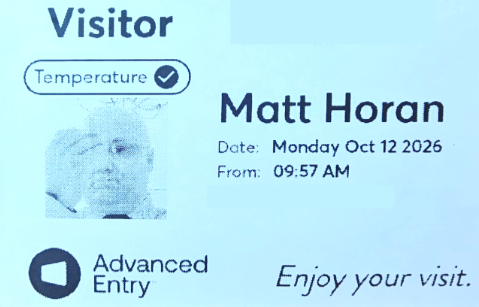
I showed the receptionist and asked, “Do I need to retake this? My hand is literally covering my face. I look like I’m trying to avoid being photographed.”
She seemed unconcerned. “Nope, if the machine says it’s fine, it’s fine.”
So I put on my nametag with my “staying incognito” picture on it, and continued on to my visit.
The person I was visiting just had her 94th birthday, and is recovering from pneumonia. A gifted piano player, she is retired from a long career as a music teacher, though after losing about 90% of her hearing, she now lives surrounded more by silence than music. I communicated with her by writing on a small whiteboard during my visit.
Despite her hearing challenges, she never misses the chance to watch our services every Sunday on the livestream. By putting in her hearing aids, and turning up the sound as loud as possible on her headphones, she is able to hear most of what happens. She knows that our organist is really good. She knows our handbells are really good. She loves seeing and hearing the singers of all ages in our choir, and loves Rob “Mr.” Knabel’s students from the East Lake High School Chorus who sing at both of our services each week. However, her favorite part of the livestream is when the camera swings around and shows her friends from church that she doesn’t get to see much anymore.
Before I left I was able to give her the gift of a prayer shawl made by members of Heritage. She told me over and over how cold she’d been that day, and since the shawl had been in my car in the sunny parking lot, it was nice and warm when I put it on her. She melted into it and I’m pretty sure that was her favorite part of my visit.
As self-conscious as I was about my nametag, she didn’t seem to care, and instead reminded me of how much you all mean to each other, and how meaningful it is that your generosity makes it possible for our homebound members to remain connected to you and to Christ’s church.
Our Financial Picture
I continue to be grateful to all of those who managed the sale of Building D. It has resulted in long-overdue repairs to AC units, the roof, the skylights in the sanctuary lobby and main hallway, and renovations to the sanctuary–including the installation of a lift that has already allowed people with mobility challenges to participate in events from the platform. There is some money still left that will be used by the building committee on renovations to the fellowship hall and kitchen, and the rest will be held in reserve in case of future hurricane damage.
The funds from the sale of Building D can be used for capital expenses or improvements, and not for the regular day-to-day expenses such as staff salaries, utilities, and supplies and equipment. Here’s a quick look at where we are today.
90% of the expenses of the average church in the United States are covered by financial contributions from the congregation. The other 10% comes from sources like fundraisers, rental income, or endowment proceeds.
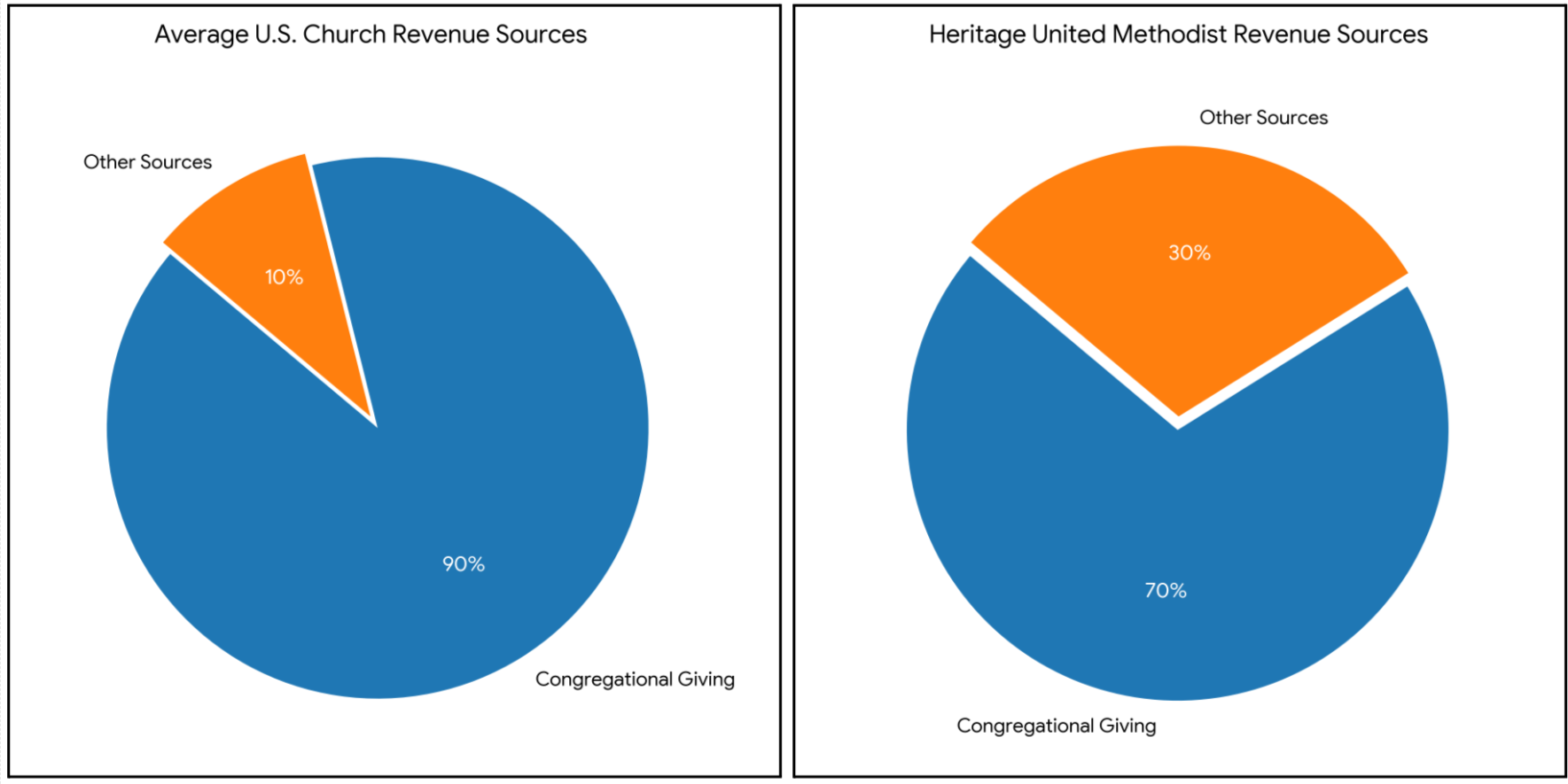
While the percentage covered by congregational giving is less at Heritage, it is still the largest source of funding used for the cost of making disciples of Jesus Christ for the transformation of the world.
So far the staff has kept expenses 4.3% under budget for the year.
We had an up and down first six months as far as our congregational giving here at Heritage. In January your giving was more than was forecasted. In February, the January gains were given back, and then some, but in March and April forecasts were exceeded again.

For the last five months in a row, (May, June, July, August, and September) however, we have fallen far short of the giving needed.
This 17.5% equates to a shortfall of $150,251.01.
As of today, wise and skillful budgeting and money management by your Heritage Leadership Boards (HLB) and other lay and staff leaders in recent years have given us cash reserves of almost $200,000. If giving and expenses were to stay as they have been so far this year, this reserve will last until November of 2027.
It is no secret that household income and expenses have been greatly affected by high gas and grocery prices in recent months, and this could be contributing to this drop in congregational giving.
It takes great faith to make financial sacrifices in an uncertain economy, so I do not bring you this update lightly. However, it is my responsibility to shepherd our congregation in our discipleship practices, as well as to keep you apprised of the state of our church.
Tithing
We do have many newcomers at Heritage these days, and so please allow me to introduce the Biblical standard churches use in regards to congregational giving in case you aren’t familiar with it.
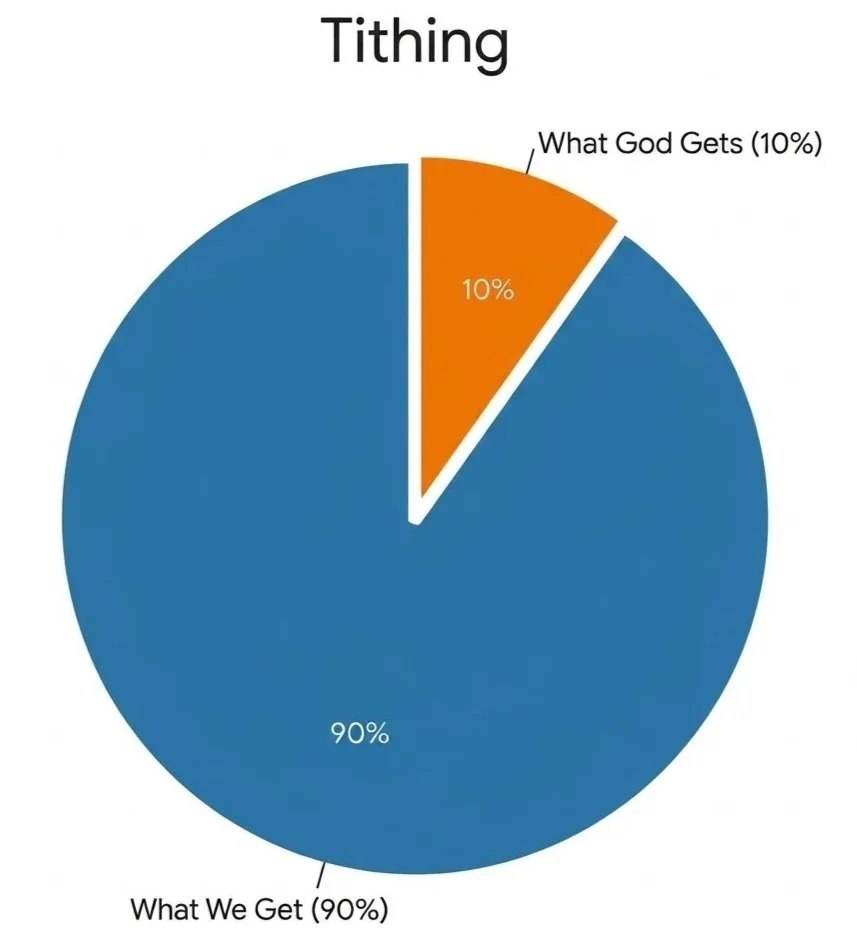
There are references to giving a tithe (the “first tenth”) of a person’s earnings throughout the Old Testament, and it is reinforced by Jesus and Paul in the New Testament, though they also talk about giving “everything.” For now let’s just stick to the tithe. 😁 God gets 10%, and we get 90%.
According to the rules at Charge Conference, my salary is announced to the congregation every year. What I make is not confidential, so let’s practice on me.
You generously pay me $1,485.58 per week. The first tenth of that (before taxes–paying the Lord before paying Uncle Sam…😁) is $148.56
You also pay for my family’s health insurance, which is 443.37. The first tenth of that is 44.34.
You also make a retirement contribution for us of $344.56. The first tenth of that is $34.46.
Since Heritage no longer owns a parsonage, you cover our housing expenses. That’s $811.52, and the first tenth is $81.15.
Susan works two jobs, making $903.85 as a school social worker and, on average, about $288 per week as a greeter at Benchmark International (Formerly Amale) Arena. The first tenth of that is $90.39 and $28.80, respectively.
When you add those up, the tithe we contribute is $427.70 per week.
I realize that household incomes are sometimes more complex than what I laid out above, but hopefully this helps with thinking through the process.
I also realize that your expenses right now may require more than 90% of your income. Further, indebtedness can have a big impact on what we have available to contribute. There are many things to consider when discerning what to contribute to the work we’re doing together at Heritage.
I know it’s a sacrifice, and there will be things we won’t be able to buy if we tithe instead. Perhaps the first tenth is completely out of reach, or perhaps giving to the church has never been something you’ve considered before. In that case, what would it look like if your goal was simply to grow a little in this area? If you’ve never contributed before, what would it look like to start? If you currently give .5%, what would it take to get to 1%?
Of course, if you’re in a situation where you can afford more, don’t let a tithe stop you! Every dime spent on our mission is a dime well spent!
Susan, Jenna, Ashley, and I count it a privilege to tithe and serve and worship alongside you!
Sincerely,

Pastor Matt